
10 Financial Reports Every Startup Should Track
Track these 10 essential financial reports—from P&L and cash flow to burn rate, runway, AR/AP and KPIs—to stay cash-safe, make smarter decisions, and build investor trust.
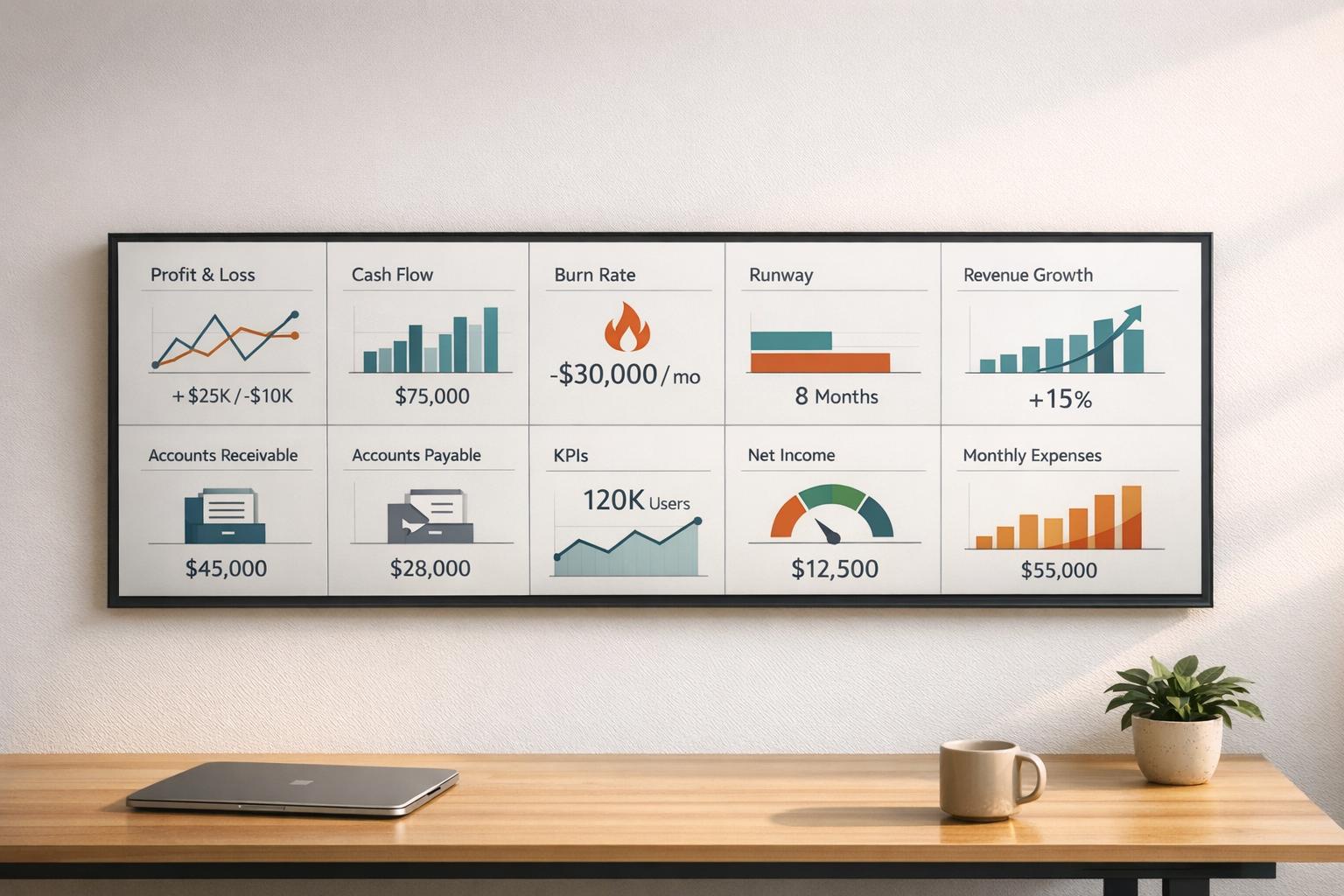
Running a startup without tracking key financial reports is risky. These reports not only help you understand your business’s financial health but also build investor trust. Here are the 10 essential financial reports every startup should monitor:
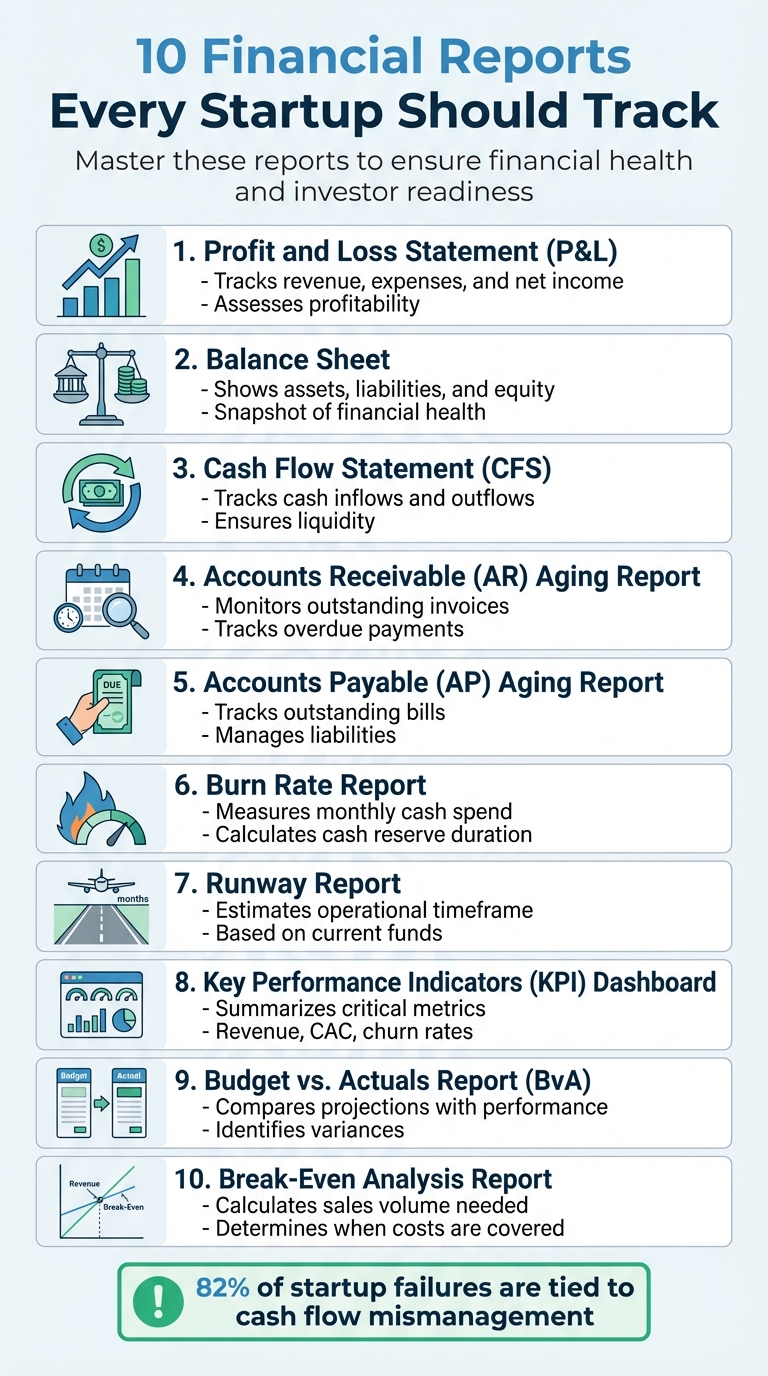
- Profit and Loss Statement (P&L): Tracks revenue, expenses, and net income to assess profitability.
- Balance Sheet: Shows assets, liabilities, and equity for a snapshot of financial health.
- Cash Flow Statement (CFS): Tracks cash inflows and outflows to ensure liquidity.
- Accounts Receivable (AR) Aging Report: Monitors outstanding invoices and overdue payments.
- Accounts Payable (AP) Aging Report: Tracks outstanding bills and liabilities.
- Burn Rate Report: Measures monthly cash spend and calculates how long cash reserves will last.
- Runway Report: Estimates the time your startup can operate with current funds.
- Key Performance Indicators (KPI) Dashboard: Summarizes metrics like revenue, customer acquisition costs, and churn rates.
- Budget vs. Actuals Report (BvA): Compares projected budgets with actual performance to identify variances.
- Break-Even Analysis Report: Calculates the sales volume needed to cover costs.
These reports provide clarity on cash flow, profitability, and growth potential, helping you make informed decisions and stay investor-ready. Tools like Afino can simplify report generation, offering services from basic bookkeeping to advanced CFO support, tailored for startups at every stage.
10 Essential Financial Reports Every Startup Should Track
1. Profit and Loss Statement (Income Statement)
Purpose and relevance for startups
The Profit and Loss (P&L) statement, also known as the income statement, provides a snapshot of your revenues, expenses, and net income over a specific period. Essentially, it answers the critical question: Are you making money?
This report is especially useful for startups because it helps pinpoint profit or loss on a product or project level, enabling you to set competitive pricing strategies. It also flags when expenses outpace revenue, giving you the chance to address financial issues before they snowball into bigger problems. Think of the P&L as the starting point in a series of financial reports that, together, give a full picture of your business's financial health. As SCORE puts it, "Your income statement can help you spot changes in costs, revenues, and profitability so you can make informed business decisions."
Impact on financial decision-making
The P&L is a powerful tool for spotting trends. Comparing year-over-year financial data can reveal patterns in product performance, helping you fine-tune your offerings to better align with market needs. Breaking down revenue into operating income (from core business activities) and other income (like interest) also provides clarity about how well your main business model is performing.
Monitoring key margins - such as gross profit, EBITDA, and operating margins - can help you measure your performance against industry benchmarks. For instance, Amazon's 2017 Consolidated Statement of Operations reported a net profit of $3.0 billion, highlighting how these metrics can reflect a company’s financial health.
Support for investor reporting and compliance
For investors and lenders, the P&L is a critical document. It provides insights into your startup's financial stability, growth potential, and creditworthiness. As Jaron Wright, Director of Financial Reporting Services at Carta, explains, "Many investors require startups to provide audited financials as part of their investment agreement." The P&L also helps calculate key metrics like Return on Equity, which investors use to evaluate financial performance.
From a compliance perspective, the P&L is indispensable for tax purposes, as it determines taxable income by subtracting operating expenses and depreciation from net operating income. Publicly traded companies in the U.S. must prepare P&L statements in line with Generally Accepted Accounting Principles (GAAP). Even if your startup isn’t public, adopting GAAP early can simplify audits and IRS filings. Ultimately, the insights gained from the P&L lay the groundwork for deeper financial analysis.
2. Balance Sheet
Purpose and Relevance for Startups
A balance sheet provides a snapshot of your startup's financial health by showing what you own (assets), what you owe (liabilities), and the owners' equity - all at a specific moment. It's built around this simple equation: Assets = Liabilities + Shareholders' Equity. This formula ensures that every dollar in assets is accounted for, either through debt or equity financing.
For startups, this document is essential because it highlights your net worth, often referred to as "book value." By subtracting liabilities from assets, you can see the potential profit if all assets were sold and debts settled. As Tim Stobierski from Harvard Business School Online explains:
"A balance sheet is a financial document designed to communicate exactly how much a company or organization is worth - its so-called 'book value'".
The balance sheet also separates items into "current" (convertible to cash or due within a year) and "non-current" (long-term), making it easier to gauge whether you have enough liquidity to handle short-term obligations. This classification lays the groundwork for conducting ratio analyses that can shape strategic financial decisions.
Impact on Financial Decision-Making
Startups use the balance sheet to calculate vital financial ratios that measure risk and liquidity. Take the debt-to-equity ratio, for example. It reveals how much of your funding comes from debt versus owner contributions. A 2:1 ratio means debt is twice the size of equity. By analyzing trends in cash reserves or debt levels, startups can make more informed decisions about reinvesting profits or seeking additional financing.
Support for Investor Reporting and Compliance
Investors and lenders depend on the balance sheet to evaluate your startup's financial stability and growth potential. Jaron Wright, CFA, and Director of Financial Reporting Services at Carta, emphasizes:
"Having timely and accurate financial reports can help you... build trust and credibility with investors, lenders, and other key stakeholders".
In many cases, investors require audited balance sheets as part of funding agreements to confirm your financial standing.
Additionally, the balance sheet plays a role in meeting regulatory requirements. Public companies in the U.S. must adhere to Generally Accepted Accounting Principles (GAAP) when preparing balance sheets. While your startup may not be public, adopting these standards early can simplify future audits and tax filings. Pay attention to the footnotes, too - they often disclose important details like accounting methods, tax obligations, and potential off-balance-sheet liabilities.
3. Cash Flow Statement
Purpose and Relevance for Startups
A cash flow statement (CFS) is like a financial reality check, showing exactly how cash moves in and out of your business. While a profit and loss statement might show revenue from a sale, the CFS reveals whether that money has actually landed in your bank account. This distinction is crucial - poor cash flow management is behind 82% of business failures.
The CFS is broken into three main parts:
- Operating Activities: Day-to-day business transactions like sales income and payments to suppliers.
- Investing Activities: Cash spent on or earned from buying and selling equipment or long-term assets.
- Financing Activities: Activities related to loans, debt repayments, and equity funding [24,25].
For startups, especially those with limited reserves, the CFS is a lifeline. It helps you calculate your burn rate and determine your cash runway - two metrics that are essential for survival.
As Tony Molina, CPA at Mercury, explains:
"In the world of startups, cash is king - and understanding your cash flow is the key to the kingdom."
This tool provides a clear picture of your cash position, helping you make informed and actionable decisions.
Impact on Financial Decision-Making
The cash flow statement is a guide for making smarter choices about hiring, budgeting, and growth [26,27]. It also reflects where your startup stands in its growth journey. For example, early-stage startups often show negative operating cash flow due to high customer acquisition costs. In contrast, scaling startups might have negative investing cash flow as they expand facilities or purchase equipment.
Keep an eye out for red flags like consistent negative operating cash flow or over-reliance on financing. These issues could indicate the need to rethink your strategy before running out of cash.
Role in Managing Cash Flow and Growth
Key metrics like Free Cash Flow (Operating Cash Flow minus Capital Expenditures) and Cash Runway (Current Cash divided by Burn Rate) are essential for understanding your financial buffer. These numbers can help you decide when to raise funds and whether you have enough cash to sustain operations.
To improve cash flow, consider practical steps such as negotiating longer payment terms with suppliers, invoicing customers promptly, and offering small discounts for early payments. Leasing equipment instead of buying it can also help conserve cash [11,27]. Interestingly, businesses using digital spend management tools see their cash-to-cash cycles improve by 17% compared to those relying on manual processes.
These strategies not only help with day-to-day operations but also build confidence among investors.
Support for Investor Reporting and Compliance
The CFS, along with your profit and loss statement and balance sheet, completes the financial puzzle, giving a comprehensive view of your business.
Investors and lenders use the CFS to evaluate your creditworthiness and how effectively you're using funds [24,29]. A consistently positive operating cash flow signals a sustainable business - not just one that's profitable on paper.
Additionally, U.S. GAAP and IFRS standards require you to produce a CFS quarterly and annually [24,7]. Keeping accurate cash flow records not only ensures compliance but also simplifies audits and tax filings by clearly documenting actual income and expenses [2,12].
4. Accounts Receivable Aging Report
Purpose and Relevance for Startups
The Accounts Receivable (AR) aging report is a crucial tool for startups focused on managing receivables. This report categorizes outstanding invoices into time intervals - such as not yet due, 1–30 days past due, 31–60 days past due, 61–90 days past due, and over 90 days past due. By breaking down receivables in this way, it becomes easier to pinpoint customers who consistently pay late and prioritize collecting older debts. Additionally, the report sheds light on locked funds, which can directly impact decisions about working capital.
Impact on Financial Decision-Making
The longer a debt remains unpaid, the less likely it is to be collected in full, making early detection of overdue invoices critical. Identifying these invoices promptly can trigger actions like automated reminders or follow-up calls to speed up collections. Metrics derived from the AR aging report, such as Days Sales Outstanding (DSO), the Collections Effectiveness Index (CEI), and the bad debt-to-sales ratio, offer valuable insights. For instance:
- A high DSO may point to inefficiencies in the collection process.
- A CEI of 80% or higher indicates strong performance.
- A bad debt-to-sales ratio under 15% reflects effective credit management, while anything above 25% signals potential issues.
These metrics guide startups in fine-tuning their credit management strategies to avoid cash flow disruptions.
Role in Managing Cash Flow and Growth
Regularly reviewing your AR aging report is essential for maintaining healthy cash flow. For startups facing persistent collection challenges, a weekly review can help keep things on track. Cross-referencing this report with sales data can also identify high-revenue customers who pay on time, fine-tuning your understanding of an ideal customer profile. Strategies like offering early payment discounts and using accounting software to automate report generation and payment reminders can speed up cash inflows while reducing manual errors. For customers who frequently fall into the 60+ or 90+ day categories, the report can highlight the need to adjust credit policies or negotiate new payment terms.
Support for Investor Reporting and Compliance
Investors and lenders often examine AR data to evaluate liquidity and how efficiently a company converts sales into cash. Up-to-date AR aging reports demonstrate financial discipline and effective credit risk management. Monthly reconciliation of AR accounts ensures accuracy and compliance with financial standards. When combined with other financial statements, the AR aging report enhances overall financial transparency, enabling startups to make timely and informed decisions.
5. Accounts Payable Aging Report
Purpose and Relevance for Startups
The Accounts Payable (AP) aging report is a key tool for tracking your startup's outstanding liabilities. It organizes these liabilities into time brackets - such as 0–30, 31–60, 61–90, and over 90 days. This categorization provides a clear view of which bills require immediate attention and which can potentially be delayed, offering valuable insights into how to manage cash flow effectively - a critical need for startups.
Impact on Financial Decision-Making
While Accounts Receivable (AR) insights focus on collections, AP reports guide spending decisions. Reviewing AP reports monthly can help you spot increasing expenses and protect your cash flow. Additionally, these reports allow you to evaluate your working capital (current assets minus liabilities) to ensure you can meet immediate financial obligations. Veronica Duckett, an Accounting and Bookkeeping Expert at Maventri, highlights the importance of strategic flexibility:
"Longer payment terms allow you to hold onto your cash longer, while early payment discounts can incentivize you to pay invoices sooner".
This balance between payment timing and cash preservation is crucial for startups working with limited resources.
Role in Managing Cash Flow and Growth
Keeping a close eye on AP helps you negotiate better payment terms and strengthen relationships with your vendors. For example, terms like "2/10 net 30" (offering a 2% discount if paid within 10 days, with the full amount due in 30) can help you save money while maintaining liquidity. Automating invoice processing and payment scheduling through accounting software can further reduce errors and give you real-time visibility into your finances. Emily Heaslip, a contributor to the U.S. Chamber of Commerce, underscores the importance of regular reconciliation:
"Reconciling these two accounts [AP and AR] monthly will make sure no bills slip through the cracks and your customers and partners are paying your business on time".
By reconciling AP and AR regularly, you ensure accurate financial records, avoid missed payments, and maintain strong vendor relationships - key factors that support financial discipline and growth.
Support for Investor Reporting and Compliance
Investors rely on AP data to evaluate your creditworthiness and how well you manage debt. AP is listed as a current liability on your balance sheet, covering obligations like vendor payments, staff wages, and utilities due within a year. Accurate AP reports demonstrate responsible financial management, which builds investor confidence. Many investors require audited financials, including detailed AP records, as part of their assessment of your startup’s stability and potential. Proper AP tracking, aligned with GAAP standards, not only strengthens your credibility but also ensures compliance with International Financial Reporting Standards (IFRS) as your business grows.
6. Burn Rate Report
Purpose and Relevance for Startups
A burn rate report tracks how much cash your business spends each month, usually calculated on a monthly basis. It answers a crucial question: how long can your startup keep operating before running out of funds? This timeline, often called your "implied runway", is critical for planning and survival.
To get a clear picture, you’ll need to monitor two key metrics: gross burn (your total monthly expenses) and net burn (expenses minus revenue). For instance, if you’re spending $100,000 monthly but bringing in $30,000 in revenue, your net burn is $70,000. With $700,000 in reserves, this gives you a 10-month runway.
Impact on Financial Decision-Making
Burn rate reports are a powerful tool for assessing whether your growth stems from genuine product-market fit or unsustainable spending. By keeping an eye on your burn rate, you can demonstrate financial discipline to investors during due diligence. Update your report monthly and prepare for multiple scenarios - best case, expected case, and worst case - so you can adjust spending if your assumptions don’t pan out.
If your burn rate seems too high, consider trimming expenses or exploring more cost-efficient ways to grow. For example, you might rethink staffing or prioritize initiatives that stretch your runway.
Role in Managing Cash Flow and Growth
Tracking your burn rate can also help you decide when to raise your next round of funding and pinpoint the revenue levels needed to break even. Startups generally begin seeking additional capital when their cash runway drops to about 5 to 8 months. For context, the average time between raising a Series B and Series C round is around 15 to 18 months.
As Lighter Capital highlights:
"Forecasting your costs - aka, your cash burn rate - is an essential practice for not only maintaining your startup's financial health but also conveying your fiscal responsibility to potential investors".
A high burn rate isn’t always a red flag. Investors may tolerate it if it’s tied to explosive user growth or the development of features with strong future revenue potential. The key is to show that your spending drives measurable progress toward meaningful milestones.
Support for Investor Reporting and Compliance
Just like other financial reports, a well-prepared burn rate report can strengthen investor confidence. Investors closely examine burn rate data to gauge spending efficiency and determine whether your startup can hit critical milestones before needing more capital. As Wall Street Prep explains:
"No investment firm wants to attempt to 'catch a falling knife' by investing in a high-risk start-up that will burn through the cash proceeds from the investment, only to call it quits soon after".
For high-growth SaaS companies, investors often expect gross margins above 75% to confirm that your burn rate aligns with a scalable business model. Additionally, make sure your burn rate reports match up with your bank statements - any discrepancies could raise red flags during due diligence. Providing accurate, timely burn rate data signals operational discipline and shows that you’re managing investor capital responsibly.
7. Runway Report
Purpose and Relevance for Startups
A runway report is a straightforward way to calculate how many months your startup can keep running with the cash you currently have on hand. It’s simple math: divide your cash balance by your monthly burn rate. For instance, if you have $500,000 in the bank and your monthly expenses are $50,000, your runway is 10 months.
This report isn’t just a number - it’s your survival guide. It helps you make critical decisions about timing and strategy. For early-stage startups, your runway should align with major milestones, like launching your product or signing your first paying customers. Just like tracking your cash flow and burn rate, understanding financial reporting for startups is critical. A short runway might push you into a frantic search for funding, while a longer one gives you breathing room to focus on growth and big-picture strategies.
Impact on Financial Decision-Making
Working hand-in-hand with your burn rate report, your runway report tells you how long your funds will last. It’s also a reality check on whether your growth plans are sustainable or if they’re eating through your cash too quickly. Investors want to see that you can hit key milestones before your money runs out.
A longer runway gives you more options. You can test pricing strategies, tweak your go-to-market plan, or explore expansion opportunities without constantly worrying about running out of cash. It’s also wise to model different scenarios - like delays in hiring or unexpected spikes in costs - so you can make informed decisions before problems arise.
Role in Managing Cash Flow and Growth
In a tougher fundraising market, aim for a runway of 18–24 months. Since venture capitalists often take 6–9 months to complete due diligence, start raising funds long before your cash reserves dip into the danger zone.
To stretch your runway, focus on practical steps like speeding up accounts receivable, negotiating better payment terms with vendors, cutting unnecessary expenses, and adjusting pricing strategies to improve profitability. Real-time tracking tools, like automated dashboards, can help you monitor your runway and make adjustments as needed. As Runway.com puts it:
"You don't die in your profit & loss statement. You die in your cash flow statement."
This quote underscores the importance of pairing runway insights with cash flow analysis so you can act before it’s too late.
Support for Investor Reporting and Compliance
Runway reports are also key to building investor confidence. Investors want to see that your startup can achieve its goals without needing an immediate cash infusion. A longer runway not only reassures them but also strengthens your position in funding negotiations. On the other hand, a short runway can leave you stuck with unfavorable terms.
Interestingly, startups that leverage professional financial advice are 78% more likely to successfully raise capital. Preparing multiple financial scenarios shows investors that you’re disciplined and prepared. It’s all about proving you’re in control of your financial future.
sbb-itb-29ec5e8
8. Key Performance Indicators (KPI) Dashboard
Purpose and Relevance for Startups
Once you've tackled the essential financial reports, bringing it all together in a centralized KPI dashboard is the next step. This dashboard is your go-to tool for tracking the metrics that truly drive your startup's progress. While general metrics might give you a snapshot of business activities, KPIs dig deeper - they measure how well you're hitting specific goals. Think of it as the pulse of your business, encompassing metrics like burn rate, runway, gross margin, customer acquisition cost (CAC), lifetime value (LTV), and the cash conversion cycle.
For tech startups, there’s a clear benchmark: investors typically look for gross margins above 75%. Alongside financial metrics, your dashboard should also keep tabs on operational factors like customer retention and churn rates. The key is simplicity - focus only on the KPIs that directly impact your performance. As Mukul Deoras, Chief Marketing Officer at Colgate-Palmolive, wisely states:
"The biggest challenge today is sifting through meaningless KPIs and focusing on the few that will yield the most crucial insights."
This streamlined KPI strategy builds naturally on the cash metrics like burn rate and runway that were covered earlier.
Impact on Financial Decision-Making
With the right metrics in place, automated KPI dashboards can demonstrate operational competence to investors. Igor Tutelman, CPA at Iota Finance, emphasizes this point:
"The most successful fundraising processes happen when founders can immediately answer detailed questions about revenue trends, customer cohort performance, and margin improvements without scrambling to reconcile conflicting data sources."
It’s no wonder that 70% of executives worldwide say KPIs significantly influence their decisions. A well-structured dashboard helps you break down profitability by business unit, monitor burn rates in real time, and create accurate financial projections. This is especially critical during Series A funding rounds, where investors scrutinize whether your growth stems from genuine product-market fit or just high-cost customer acquisition. Scenario modeling also becomes a game-changer, allowing you to adjust spending as market conditions evolve.
Role in Managing Cash Flow and Growth
Keeping a close eye on KPIs is essential for managing cash flow effectively. Cash shortages are a leading cause of business failure, with about 38% of companies running out of funds. A robust KPI dashboard gives you real-time insights into your cash-generating activities and highlights potential financial risks. For example, the cash conversion cycle helps you measure how quickly you turn resources into cash, ensuring you meet obligations and avoid penalties.
Automated dashboards that update daily provide a clear view of your financial health. By setting trigger points based on historical trends, you can adjust spending, delay investments, or secure funding before your resources run dry.
Support for Investor Reporting and Compliance
Investors want to see that you’ve got a firm grip on your cash flow and the ability to scale sustainably. Metrics like burn rate efficiency and automated, transparent reports reassure them that you’re managing resources wisely. For SaaS companies, maintaining gross margins above 70% is often a critical benchmark for Series A investors.
Monthly financial reports can also catch integration issues early - whether between payment platforms or accounting systems. Organizing your dashboard into clear categories - like Financial (profit margin), Sales (CAC), and Customer Satisfaction (churn rate) - provides a complete picture of your business for both you and your investors.
9. Budget vs. Actuals Report
Purpose and Relevance for Startups
The Budget vs. Actuals (BvA) report is a straightforward way to keep your financial planning on track. It compares your projected budget with actual financial results, highlighting the "variance" - the difference between what you planned and what actually happened. As Deb Howard Greenleaf, CEO of Greenleaf Accounting Services, explains:
"The Budget vs Actuals Report is your reality check for how close you are to your goals for the year."
This report typically includes Actual results, Budget projections, Over Budget variance, and the % of Budget achieved. For startups, especially in unpredictable markets or during periods of significant change, such as adapting to new technologies or recovering from global disruptions, this monthly analysis is crucial. In fact, roughly 66% of organizations now use automation tools to track financial variances. By identifying discrepancies, the report helps you make informed adjustments to stay aligned with your financial goals.
Impact on Financial Decision-Making
Significant variances deserve extra attention - particularly in the % of Budget column, where even a small dollar difference might signal deeper issues. Brianna Blaney, Financial Writer at Tipalti, underscores this point:
"Knowing the 'why?' is the first step in determining next steps."
Digging into large discrepancies and recurring losses allows you to address problems before they grow. This process also sharpens future forecasts, improving the accuracy of your financial planning over time. These insights play a direct role in managing cash flow problems and making strategic adjustments as needed.
Role in Managing Cash Flow and Growth
By comparing your projected and actual cash flows, you can take immediate actions like speeding up invoicing, negotiating better supplier terms, or reallocating surplus funds. Running this analysis monthly helps you catch potential financial issues early. Regular BvA reports also reveal trends - such as declining sales or increasing operational costs - so you can address problems before they spiral out of control.
Support for Investor Reporting and Compliance
Accurate BvA reports are a powerful tool for building trust with investors and lenders. They provide transparency into your financial health and highlight your ability to manage risks effectively. These reports also ensure you're ready for financial audits, which are often required under investment agreements. Showing stakeholders that you actively monitor variances and adjust your strategy based on data demonstrates your operational competence and your potential for sustainable growth.
10. Break-Even Analysis Report
Purpose and Relevance for Startups
The Break-Even Analysis Report pinpoints a critical milestone for startups: the moment when total revenues match total expenses, marking the end of losses. Essentially, it answers the question: How many units do you need to sell to cover all your costs?
To calculate this, divide your fixed costs - such as rent, salaries, and insurance - by the contribution margin. The contribution margin is the selling price of one unit minus its variable costs, like raw materials. For example, if your fixed costs are $2,000 and your contribution margin per unit is $8, you’ll need to sell 250 units to break even. This analysis is a must-have tool to guide startups toward profitability.
Impact on Financial Decision-Making
Understanding the break-even point gives you a clear picture of your cost-revenue balance, helping you make more rational financial decisions. As Investopedia puts it:
"The breakeven point occurs when revenue exactly equals total costs, when the money coming in equals the amount going out the door."
This clarity can help you fine-tune pricing strategies, assess whether your operating costs are sustainable, and evaluate whether your business model is financially sound. It’s a practical way to ensure that better cost control can lead to profitability more quickly.
Role in Managing Cash Flow and Growth
The U.S. Small Business Administration highlights the practical benefits of this analysis:
"Finding your break-even point will help you price your products smarter."
Knowing your break-even point allows you to set realistic sales goals and adjust costs accordingly. If the sales volume required to break even seems unattainable, it’s a signal to make changes - whether that means increasing prices, reducing variable costs, or even rethinking your business model. For SaaS startups, for instance, investors often expect gross margins between 70% and 90% to ensure a faster route to profitability. Treat this analysis as a dynamic tool, revisiting it regularly as costs like rent or payroll evolve.
Support for Investor Reporting and Compliance
Investors care not only about potential returns but also about the timeline for achieving them. As noted by the U.S. Small Business Administration:
"Potential investors in a business not only want to know the return to expect on their investments, but also the point when they will realize this return."
Including break-even projections in your pitch deck signals that you’ve thought through your financial strategy and have a clear plan for profitability. Many investors require this analysis as part of your business plan before committing funds, whether through debt or equity. To account for unexpected expenses, it’s wise to include a 10% buffer in your projections. This report, like others, reinforces the disciplined approach that investors value.
The Ultimate Guide to Financial Statements
How Afino Makes Financial Reporting Easier for Startups

For early-stage founders juggling product development and customer acquisition, managing financial reports can feel like an uphill battle. Afino steps in to simplify this process with its bookkeeping and CFO services, delivering US GAAP-compliant books that seamlessly generate the reports you need. By automating these tasks, Afino frees up founders to focus on growing their businesses instead of getting bogged down in record-keeping.
Afino's Bookkeeping service, priced at $400 per month, covers essential tasks like recording transactions, reconciling bank and credit card accounts, and offering insights through key reports such as the Profit & Loss statement, Balance Sheet, Cash Flow Statement, and Accounts Receivable/Accounts Payable Aging Reports. For startups with more intricate financial needs - like managing complex integrations or tracking detailed KPIs - the Advanced Bookkeeping service provides custom dashboards and Budget vs. Actuals reporting, keeping your finances aligned with your growth strategy. These services are designed to scale with your business, evolving into strategic support as your needs grow.
When fundraising or navigating rapid expansion, Afino’s CFO Services ($1,740 per month) become indispensable. Fractional CFOs create critical reports such as Burn Rate, Runway, and Break-Even Analysis. They also develop custom financial statements and operating models tailored to your business stage, ensuring your financials are investor-ready and reconcile smoothly with bank data during due diligence.
| Service Level | Monthly Cost | Best For | Key Reports Supported |
|---|---|---|---|
| Bookkeeping | $400 | Early-stage, low transaction volume | P&L, Balance Sheet, Cash Flow, AR/AP Aging |
| Advanced Bookkeeping | Custom | Scaling startups with complex needs | All of the above, plus KPI Dashboards and Budget vs. Actuals |
| CFO Services | $1,740 | Fundraising or high-growth startups | All of the above, plus Burn Rate, Runway, Break-Even Analysis, Financial Modeling |
Afino’s tiered approach ensures that your financial data doesn’t just sit idle - it becomes a powerful tool for decision-making. With nearly 66% of small-business owners struggling to maintain consistent cash flow, Afino's expert team ensures you’re not just managing numbers but transforming them into strategies that fuel sustainable growth.
Conclusion
Keeping track of these 10 financial reports lays the groundwork for steady growth. Research indicates that 82% of startup failures are tied to cash flow mismanagement, emphasizing the critical role of understanding your financial data in determining success or failure. These reports provide a comprehensive snapshot of your business, covering everything from daily cash flow to long-term financial health, empowering you to make informed, data-backed decisions.
Accurate financial reporting doesn’t just help you manage your business - it also demonstrates professionalism to potential investors. As Igor Tutelman, CPA at Iota Finance, puts it:
"Nothing signals operational maturity like financial reports that investors can trust from day one of due diligence".
When competing for funding - especially in challenging markets - having reconciled, up-to-date reports gives you a distinct advantage. Investors dig deep into margins and scrutinize every detail to evaluate whether your business model has room to grow.
But the value of consistent financial reporting goes beyond attracting investors. It acts as an early warning system, helping you spot problems before they escalate. If expenses start outpacing revenue or your runway shrinks faster than expected, these reports give you the clarity to make timely adjustments. By keeping a close eye on your numbers, you can reallocate budgets effectively and seize opportunities before your competitors do. This proactive approach also makes it easier to bring in expert financial guidance when needed.
To make this process seamless, Afino offers services designed to handle your financial reporting while ensuring everything stays US GAAP-compliant and ready for investor review. Whether you need basic bookkeeping for $400 per month or strategic fractional CFO services for $1,740 per month, Afino grows with your business. They transform raw data into actionable insights, helping you protect your investment and build a business that stands the test of time.
FAQs
Why is it important for startups to monitor their burn rate?
Keeping track of your burn rate is crucial for a startup's survival. It reveals how fast you're depleting your cash reserves, giving you a clear picture of how long your business can sustain itself before you need more funding or reach profitability.
By monitoring this metric closely, you can make smarter decisions - whether it's trimming expenses, seeking additional funding, or tweaking your growth strategy. Burn rate serves as a vital measure of financial health and an essential tool for shaping your startup's future.
What is a KPI dashboard, and how can it help a startup grow?
A KPI (Key Performance Indicator) dashboard is an essential tool for startups, offering a real-time view of the metrics that matter most. This user-friendly interface provides a quick snapshot of a company’s financial and operational health, making it easier to make informed decisions on the fly.
By tracking metrics like revenue growth, profit margins, burn rate, and customer acquisition costs, founders can uncover trends, spot potential challenges early, and adjust their strategies accordingly. It also plays a key role in strategic planning by showcasing growth drivers, such as sales performance and operational efficiency.
Real-time insights from a KPI dashboard allow startups to allocate resources wisely, focus on high-priority initiatives, and demonstrate progress to investors - especially crucial during fundraising or scaling phases. In essence, it simplifies complex data, turning it into actionable insights that help startups stay nimble and competitive.
How does the Budget vs. Actuals report help startups make better financial decisions?
The Budget vs. Actuals report plays a crucial role for startups, as it highlights the differences between planned financial goals and actual outcomes. This comparison sheds light on any gaps, helps track progress toward financial targets, and pinpoints areas that may need adjustments.
Regularly reviewing this report allows startups to make smarter decisions - whether that’s reallocating resources, controlling expenses, or updating revenue forecasts. It’s a key tool for maintaining financial oversight and ensuring the business stays aligned with its strategic goals.